
St Michael’s Church
Horton

About Us
St Michael’s is a 12th Century Romanesque Gem,
half-way between Windsor Castle and Heathrow Airport
St Michael’s has a living, worshipping community, that values the tradition received from the past, yet lives in the present and looks to the future.
Photo Gallery
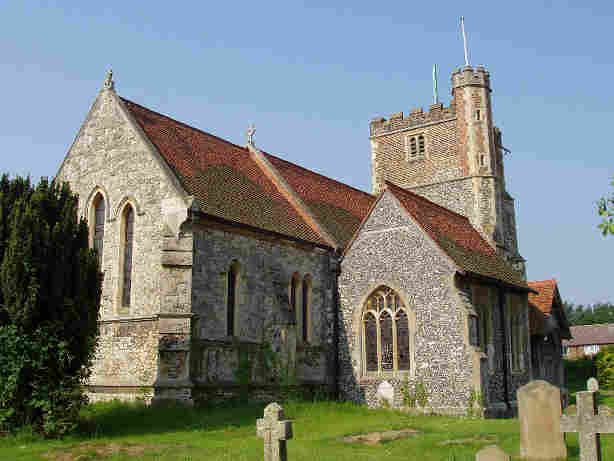
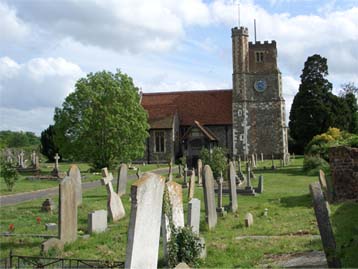
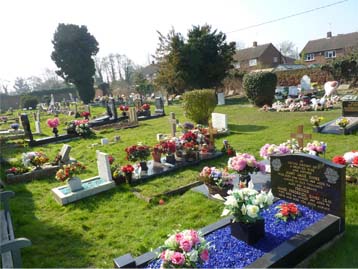
Original website content: History of St Michael’s Church
History - The Site and Setting
The Church, lying half-way between Windsor Castle and Heathrow Airport as the ‘planes fly, is not only one of the oldest in the district, dating from c.1160, it is also one of the prettiest.
It is built of a medley of materials including flints, white clunch, limestone and red bricks.
The church set on the edge of the village centre, well back from the road, is unusual in that its principal entrance door is on its north side.
Immediately south of the church once stood Place House, a large tudor house (demolished in 1785). Until 1877 the church had a nearby entrance door in the west wall of the south aisle: a private doorway in the churchyard wall still remains.
History - The Building
The Interior
The two most notable features are the roof and the south arcade. The massive mediaeval roof has two great tie-beams supporting octagonal crown-posts from each of which branch two braces. This structure is generally confined to south-east England. The late 12th century arcade has two large round piers and three slightly pointed arches. The soffit (underside) of the western-most arch has traces of 12th century painted decoration in red pigment.
Other Features of the interior
The Font
The font is 12th century, with a simple rope moulding. It is a large tub (1 metre across) and big enough for a baby to be totally immersed.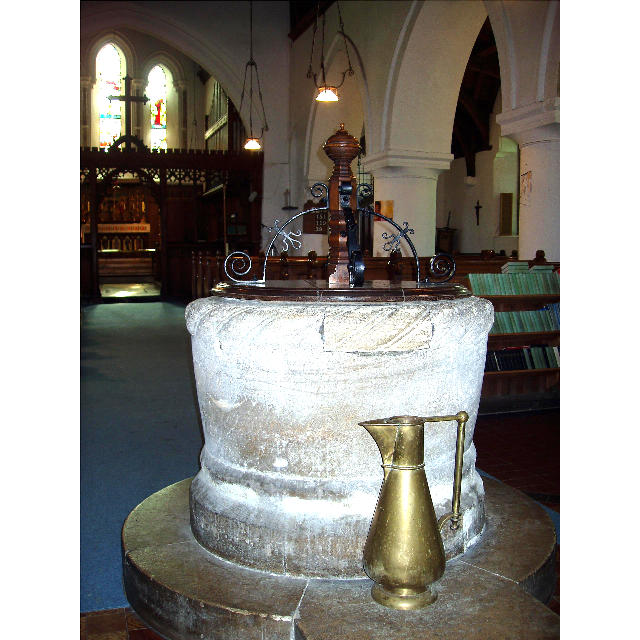
The Screen Stairs
At the end of the south arcade which led to a mediaeval wooden screen under the chancel arch.
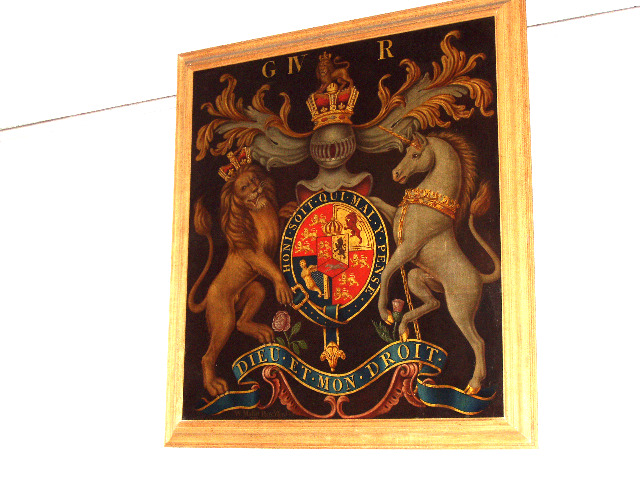
The Royal Achievement
Of William IV (1830-37) on the north wall shows the Hanoverian arms with an elector’s crown. After many decades of storage in the ringing chamber it was restored and rehung in 1982.
The Tower Arch
The tall, four-centred tower arch with polygonal jambs is later 15th century perpendicular; the small door and doorway to the stair turret are also late 15th century as are the moulded ceiling-timbers. Notice the fove guide holes in the ceiling for bellropes.
The North Chapel
Is entered by the lovely continuous 14th century arch. There is a simple brass chandelier of 1728, and a mediaeval piscina. The altar is a memorial to the village dead of the Great War.
The chapel was formerly the responsibility of the Lords of the manor whose big private pew is shewn in Scott’s plan. In the 17th and 18th centuries the manor was held by the Scawens , many of whom were interred in a vault (now closed) below the chapel floor. They were buried in linen for which they paid a levy of £50; everyone else was buried in wool, a government stipulation to encourage the wool industry. A huge and elaborate memorial to them occupied much space in the chapel, but disappeared during the restoration.
The Chancel
There are head corbels on either side of the 14th century chancel arch. There is a half a 15th century poppyhead pew-end by the north wall. (The only pre-reformation woodwork in the church apart from the two tower doors.) Most of the chancel was rebuilt in C13th style, possibly enclosing earlier walls, in the mid-C19th. There is a 19th century mosaic of flowers on the floor of the sanctuary.
Chancel Monuments
- Two purbeck marble slabs (partly under the organ platform)
(a) with indents for brasses of a civilian, his wife, 2 sons and 2 daughters (c.1490)
(b) slab with indent containing rivets and plugholes for brass.Appropriated for Robert Nanney, Rector, who died in 1734.
- Centre chancel:(a) Tournai marble slab, to Sarah Milton, 1637 mother of the poet John Milton
- On the north wall is a marble cartouche monument, with a curved face, to Robert Nanney who married into the Scawen family. It was transferred from the south wall when the organ was installed by J W Walker & Son of London in 1880.
The Organ
The organ of 1880 cost £305. The pointed tops to the pipes and the stencilled decoration are unusual; they were made at the insistance of Avery Tyrrel of Berkyn Manor who defrayed the cost. It was overhauled by J W Walker in 1996 at a cost of £20,887 and 38p!
The Bells
The oldest bell ( a rare example of one cast during the civil war) is inscribed “Feare God 1647”. A sixth bell, (the treble – the smallest bell) was added in 1897 to commemorate Queen Victoria’s Diamond Jubilee. It cost £200, provided by the premium for the least of the Five Bells public house, at that time owned by the Church Lands Trustees.
List of Rectors
Near the font. The illuminated list of 1950 shows the succession from 1208 to 1948.
Glass
Most of the painted glass dates from 1880-1905 and is by C E Kempe. His wheatsheaf trademark can be seen in two of the chancel windows.
The three East Chancel wall lancets depict the three figures of the Crucifixion (The Virgin, Christ and St John) which were formerly shewn on mediaeval roodscreens. Each lancet also shows a poet in its lower part:
- to the left is Caedmon (dc 680) the earliest English poet
- in the centre is King David composing the psalms
- on the right, writing Paradise Lost, is John Milton who lived (from 1632-1638) in the village to which his father (a London lawyer) had retired.
Electricity
This was installed in 1927 at a cost of £66 14s. 5d, by the Datchet and Slough Electricity Supply Company. The frames of the earlier oil lamps were retained to suppor tthe electricity bulbs, which they still do. The porch lantern still incorporates a copper oil lamp.
The Porch and North Doorway
The 16th century porch, rebuilt in the 1870s is timber-studded above a brick plinth. The external oak doors below the pretty cusped bargeboards are of 1970. The proch protects the church’s architectural gem, the North doorway.
This richly decorated C12th doorway has a semi circular arch with four orders of decoration and is flanked by a pair of shafts with scallopped capitals. The two orders of bead-and-reel and chevron are unusual in that they extend to the ground. An interesting feature is that the voussoirs (wedge-shaped stones) are alternativing yellow limestone and white clunch. The north position and the softness of the clunch stone means that the door
History - The Restoration of 1876/7
This extensive and quality restoration was undertaken by John Oldrid Scott (1842-1913), son of Sir George Gilbert Scott).
The restoration cost £3,000, towards which Queen Victoria subscribed £50. Dating from this restoration are the pews in chestnut; the pulpit, screen and lectern. The oak pulpit has panels carved in 1888 by a former resident, Mrs Hancock; within it is a consecration cross.
The north porch was restored, a new north door and hingest made, the floor was re-laid with red tiles and a selection of tombstones was laid down the aisles. (Other tombstones found their way to the (Old) Rectory garden!).
Scott’s plan of the church prior to the restoration is on the west wall. It shows the west doorway to the south aisle, box pews for the gentry and, against the tower arch, stairs to a gallery.
History - The Churchyard
Both the lych gate and flint churchyard wall date from 1886. The other walls, associated with the former Place House, have massive C16th bricks measuring 14 × 6 × 4½ (35 × 15 × 11cm).
The Tree of Heaven (Ailanthus glandulosa) was planted near the lychgate in 1973 to replace a giant yew which was destroyed in a storm in 1970.
Nearby are some C19th wooden leaping-board grave markers. This unusual style of monumnet is found occasionally in south-east England in wood, stone or cast iron.
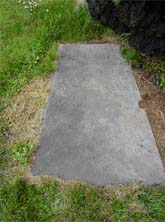
Old Churchyard - Monuments - Biddle, Thomas (d.1721)
Thomas Biddle d.1721
Here lyeth the body of Mr Thomas Biddle Esqr, late of Colenbrook
who departed this life September the ?3rd 1721 Aged 77 years
Here also lyeth the body of Mrs Elizabeth his Wife
who departed this life September the ?12th 1721 Aged 76 years Here lyeth also the body of Susanna Smith widow the youngest Daughter
of Thomas and Elizabeth Biddle who died X?? of October 1742 aged 49
(There is also an additional line (currently unreadable) which, according to the 1862 book by Gyll reads)
Mr. Robert Biddle, died December 1743, aged 60.
Notes
Horton’s Parish records showed the burials ‘in woollen’, two days apart, of Thomas and Elizabeth, he was described as a Cooper. His will, dated August 1721 names two sons, Robert and Thomas and three daughters, Ann Blackman, Elizabeth Fleetwood and Susan Smith. Susannah Biddle had married Samuel Smith, a Bricklayer of Great Marlow in August 1720, he died in October 1721. Robert Biddle’s will, signed in 1742 names his wife Mary, son Thomas and the youngest child of his sister Ann Blackman. Elizabeth Fleetwood was buried at Horton in 1735, Ann Blackman in 1741
Travelling Home "A celebration of unity"
A previous Travelling Home event was held on Sunday 16th July 2017, starting at St Michael’s Church at 4.00pm with a short service and blessing of the churchyard.
Refreshments followed at Champney Hall.
December 2016 – Travelling Home article in Oxford Diocese News
July 2015 – Terry Doe’s first talk at the Travelling Home service
Link: https://drive.google.com/file/d/1tRlHowORJqQtOmr_c1uEj4HpbMqYEhAN/view?usp=share_link
July 2017 – Terry Doe’s talk at Travelling Home 3
Link: https://drive.google.com/file/d/1xUd5r_t0XpKNOK3TgDSUuuPABsgzldUa/view?usp=share_link
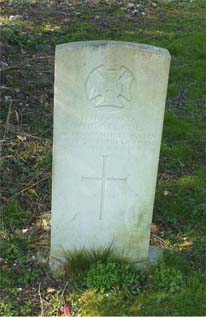
Extension Churchyard - Monuments - Oxlade, William (d.1916)
William Oxlade died of wounds 1916
3651 Private
W. H. Oxlade
Buckinghamshire Battn.
Oxford & Bucks Light Inf.
23rd July 1916 age 18
Notes
William was the son of James (Isaac James) Oxlade and his wife Rebecca Springle. He was born in 1898 and in 1901 he was living with his father, seven older siblings, and one younger sibling in Wooburn, High Wycombe. His mother had died at the beginning of 1901.
In 1911 he was at school and living with his father in Mill Street, Colnbrook. Also living with them was his older sister Mary, by then a widow with a small son, an older brother and one younger sister.
He served in the Oxfordshire and Buckinghamshire Light Infantry and died of wounds on 23 July 1916 at the London Metropolitan Hospital.
He was buried in St Michael’s churchyard on 27th July.
Extension Churchyard - Monuments - Evans, Ft.Lt.J C (d.1945)
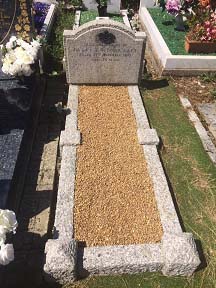
Evans, Ft-Lt John Collenette d.1945
In loving memory of
Flt.Lieut J C Evans RAFO
Killed 27th November 1945
Aged 35 years
Notes
John Evans was the son of Florence Collenette and John Llewellyn Evans. a Physician who was originally from Guersey. John was born in September 1910.
John was killed in an air crash in December 1945. He was a test pilot flying a Fairey Firefly MK1 which crashed at Hythe End in Wraysbury in 1945. It was established that the cockpit hood had distorted and detached, stunning the pilot in the process. The Fairey Firefly was a British Second World War-era carrier-borne fighter aircraft and anti-submarine aircraft of the Fleet Air Arm (FAA).
John was granted a Short Service Commission in the RAF in 1933 and transferred to the Reserve in 1937. In 1938 he married Valerie Vickers and at the time of his death was living in Slade Lane, Iver. Valerie later remarried John Kelway.
(In the last couple of weeks – August 2016 – this grave has been scrubbed, restored and had new gravel – all the work done by a marvellous team of volunteers)
Stanwell Rd, Horton, Berkshire SL3 9PA
Church Office: 07543 539569
Email: Office@CHWChurches.org

REQUEST PRAYER
Your prayer will be passed onto our pray team who will pray for you. You do not have to leave any personal details about yourself unless you would like us to contact us directly.
There are many reasons why we might want to pray – because we are searching for the right relationship, because we long for true communication, because we are searching for meaning because our heart if overflowing, because we are at our limits, or because we feel compassion.
If you would like to join in prayer, want prayer support or have an issue that you would like prayer for, please contact us.

LIfe Events
- Baptism
- Weddings
- Funerals
- Pastoral Support
- Alpha Course
- Youth Alpha
Church Connections
- House Groups
- Children Youth and Families
- Bell Ringing